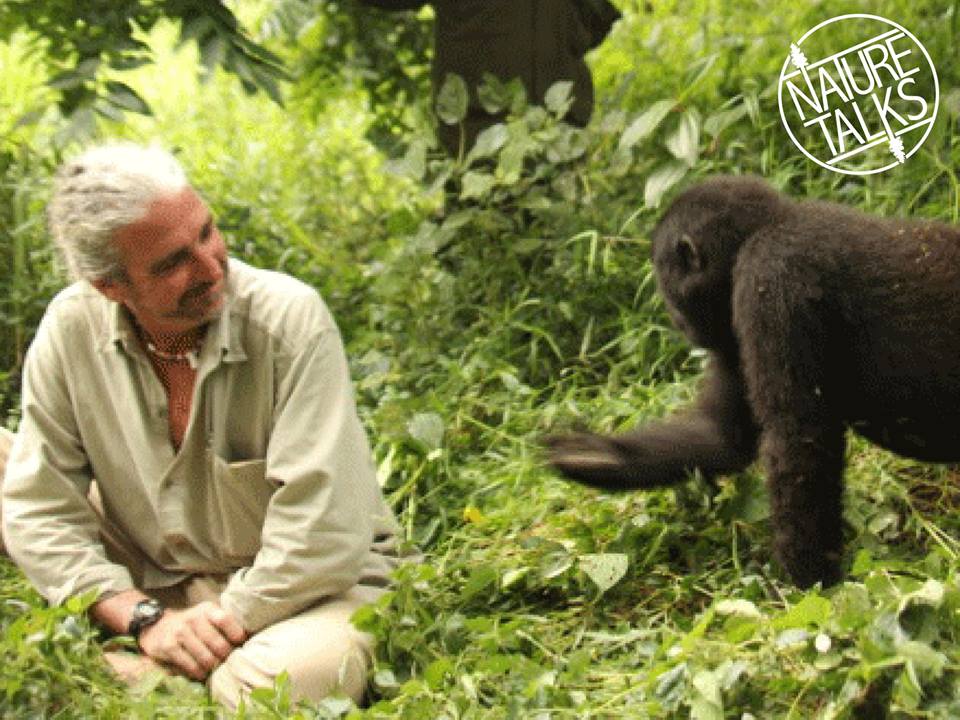
Bespoke safaris beyond your imagination. Visit gorillas where they live, on foot in the wild. Trek the afro-montane forests of the Albertine Rift Valley. Bushwhack remote eco-systems in the Congo Basin. Boat up river through the jungles of Gabon. Hunt with the Ba'aka pygmies in Dzanga Shanga. Join our next expedition to Gorillaland, where it all began and still goes on.
In my memoir,Gorilla Tactics: How To Save A Species (soon to be published in the United States by Chicago Review Press), I describe in detail the dramatic moment in October 1992 when I first came face to face with my hairy mountain cousins. Here's a short excerpt from my, as yet, unpublished manuscript:
The wind blasts a hole through the mist and for a moment we can see Lake Kivu and the town of Gisenyi a few thousand metres below us. We then find Group 5’s night nests. A forward tracker assures us over walkie talkies that the gorillas are not far. We descend into a saddle and are surrounded by giant lobelia plants. There is an unusual odour in the air, like a workman’s armpit after a hard day’s toil. Bob tells me it is a fear odour that gorillas give off when they sense danger. I imagine they can smell us too. They probably know I drank a barrel of banana beer last night. A gorilla is sheltering from the rain beneath a hagania tree. But for a faint reflection in his dark eyes when he briefly glances at us, his form is barely discernible in the faint light. He sits perfectly still. He will not move until the rain stops, or I cross a line. Bob makes a well-rehearsed guttural sound with his throat, known as a belch-vocalization, which in gorilla language means, “Everything’s cool.” More gorillas appear. I am relieved that we have found them. Rainfall facilitates our entry into their world. Around us the foliage glistens. Despite the high average rainfall in their habitat, by all appearances gorillas do not much like the rain. They remain stock still, shabby black forms huddled together, hardly even looking up.
It has been 30 years since I first met gorillas in the wild and, though I've since revisited them dozens of times, the experience is unfailingly thrilling. By chance, after a spell in Mexico and Sicily this summer, I'll soon be returning to the Bright Continent. African drums are calling... Can you hear them? Are you a little stir crazy, impulsive, adventurous? Why not join me on a gorilla safari? Situated in the ancient and enchanting seaside town of Malindi, Kenya - a short flight away from their habitats - I'll be available on short notice to take couples or small groups to meet gorillas in either Bwindi Impenetrable Forest, Uganda or Volcanoes National Park, Rwanda. Your choice. It's a walk in the park.Feel free to contact me any time. Details below. Thank you for your interest. I'd be delighted to be your experienced gorilla guide.And the big fellas would love to meet you too...
Two Weeks in Uganda & Kenya, featuring the Albertine Rift Valley, Kenya Coast, Tsavo, and Amboseli national parks - featuring gorilla and chimpanzee trekking, ocean activities, and game drives - staying in luxury accommodation and traveling by safari vehicle and aircraft
●●◦◦◦◦▶◆◈◦◈◍▨◯▧◍◎◍▨◯▧◍◈◦◈◆◀◦◦◦◦●●
Day 1: Arrive Entebbe International Airport (EBB). Transfer (30 min) by boat to Bulago Island, one degree south of the Equator. Bulago is the hub of a sustainable marine and endangered animal reserve. Relax on the shores of Lake Victoria, the world’s largest tropical lake. Overnight at the One Minute South villa. Day 2: Transfer (30 min) by boat to Entebbe, then (4 ½ hrs) by road to Kibale Forest National Park, the most accessible of Uganda's major rain forests and home to a remarkable thirteen primate species, including habituated chimpanzees, our closest relative in the wild. Overnight at the Primate Lodge. Day 3: Morning chimpanzee trekking. Kibale’s 1,450 chimpanzee represent Uganda’s largest population of this endangered primate. Other primates include l’Hoest’s monkey, red colobus monkey, black and white colobus, blue monkey, grey cheeked mangabey, red tailed monkey, olive baboon, bush baby and potto. Transfer (½ hr) by road to Bigodi Wetland Sanctuary and see how local communities are working together to maintain this stunning wildlife reserve. Night walk to look for nocturnal primates. Overnight at the Primate Lodge. Day 4: Transfer (4 hrs) by road to Ishasha for an afternoon game drive to spot tree-climbing lions, elephant, hippos and a vast array of antelope, some only found in this remote corner of the Albertine Rift. Transfer (2 ½ hrs) by road to Bwindi Forest. Overnight at Sanctuary Gorilla Forest Camp.
Day 5: Gorilla trekking in Bwindi Impenetrable National Park, on the steep, rain-soaked slopes of the Bufumbira Mountains. A modicum of fitness is required to trek Mountain gorillas. Bwindi comprises 331 square kilometers of jungle forests and contains both montane and lowland forest, and is accessible only on foot. The park provides habitat for some 120 species of mammals, 346 species of birds, 202 species of butterflies, 163 species of trees, 100 species of ferns, 27 species of frogs, chameleons, geckos and many endangered species. The fur of the Mountain gorilla, often thicker and longer than that of other gorilla species, enables them to live in colder temperatures. Gorillas can be identified by nose prints unique to each individual. Males usually weigh twice as much as the females, and this subspecies is on average the largest of all gorillas. Adult males have more pronounced bony crests on the top and back of their skulls, giving their heads a more conical shape. These crests anchor the powerful masseter muscles, which attach to the lower jaw (mandible). Adult females also have these crests, but they are less pronounced. Like all gorillas they feature dark brown eyes framed by a black ring around the iris. Afternoon walk to the Pygmy community for a rich cultural exchange with Africa’s original inhabitants. Overnight at Sanctuary Gorilla Forest Camp. Day 6: Transfer (1 ½ hrs) by air to Entebbe. A leisurely lunch at The Gateley Inn. Transfer (2 hrs) by air to Nairobi, then (1 hr) by air to Malindi. Overnight at Backpackers Club Malindi.
Day 7-8: Wind down beside an olympic sized pool at our elegant ocean-front villa, set on two shady acres of palm and frangipani groves (with a resident troop of Sykes monkeys), and surrounded by silver sand beaches. Overnight at Backpackers Club Malindi. Malindi add-ons:
Day trip to the Lost City of Gede and Watamu - lunch, Italian cuisine at Papa Remo Beach.
Day trip to Che Shale, pristine beach north of Malindi - lunch, soft-shell crab at Che Shale, best in East Africa.
Half day, dhow cruise aboard Big Mama, from Driftwood to the Mayungu sandbar for sundowners.
Half day to Sikoki Forest to spot butterflies.
Day 9: Transfer (2 hrs) by road to Tsavo East National Park, one of the oldest and largest parks in Kenya. Most of the park consists of semi-arid grasslands and savanna. It is considered one of the world's biodiversity strongholds, and its popularity is mostly due to the vast amounts of diverse wildlife that can be seen, including the famous 'big five' consisting of Masai lion, black rhino, cape buffalo, elephant and leopard. Overnight at Satao Luxury Tented Camp. Day 10: Game drive through Tsavo East. Tsavo lions, a population where adult males often lack manes entirely, total about 675 lions in the Amboseli-Tsavo ecosystem. Overnight at Satao Luxury Tented Camp. Day 11: Transfer (3 hrs) by road to Lumo Community Wildlife Santuary. The greater Tsavo Conservation Area is a vast, wild region of awe-inspiring natural beauty and incredible biodiversity. The area boasts Kenya’s single largest population of elephants – famously red in colour due to Tsavo’s rusty earth tones – numbering 11,000 animals at the last census (February 2014). This might sound like a good many elephants – but not when you consider that in the late 1960s there used to be 35,000 in Tsavo, and that the numbers have dropped by 1,500 since the last count three years ago. Among the surviving population is arguably the world’s last viable gene pool of elephants carrying exceptionally large ivory. Overnight at Lion's Bluff Lodge. Day 12: Transfer (2 hrs) by road to Lake Jipe, at the foot of Mt. Kilimanjaro. Overnight at Grogan's Castle.
Day 13: Transfer (5 hrs) by road to the Sheldrick Trust Orphan’s Project, which has achieved world-wide acclaim through its hugely successful elephant and rhino rescue and rehabilitation program. The Orphans’ Project exists to offer hope for the future of Kenya’s threatened elephant and rhino populations as they struggle against the threat of poaching for their ivory and horn, and the loss of habitat due to human population pressures and conflict, deforestation and drought.. Overnight at Ithumba Camp. Day 14: Transfer (1 hr) by air to Wilson Airport, Nairobi. Transfer (45 min) by road to Jomo Kenyatta International Airport (NBO) for your intercontinental flight.
For millions of years, bipedal hominids inhabited the region known today as East Africa, in particular the Great Rift Valley. With its rugged terrain and rich savannas teaming with proteinaceous wildlife, it’s easy to see why. Then, 60,000 years ago, stressed by climate change, our human ancestors migrated out of Africa, leaving a handful of fellow humans behind. And for countless generations this wild wonderland remained in equilibrium with its inhabitants.
But over the past 50 years, as East Africa’s human population has quadrupled, its wildernesses have been encroached and its wildlife populations significantly depleted. Sadly, it is inevitable that within the next two generations this wild wonderland will all but perish. That is, unless East Africa’s wildlife authorities can earn enough money from their protected areas to maintain them.
Accordingly, I will be leading an exclusive eco-tour through East Africa’s Great Rift Valley, tailor-made for the discerning traveler who wishes to experience this wonderland before it vanishes (and possibly save it). Together we will trek the rain forests of the Western Rift in search of Great Apes, explore the savannas of the Eastern Rift to spot the Big Five, and then take to the wide open beaches of the Swahili Coast to fully unwind.
Along the way, I will introduce you to a handful of the many tribes who occupy the region: the Bakiga, Banyankole, Bambuti, Baganda, Masai, and Coastal Arabs. You will get a chance to learn their language, customs and views. They have lived in the region for centuries without bringing about its destruction, and may have something to teach us about wildlife protection.
As executive director of the Gorilla Organization (formerly the Dian Fossey Gorilla Fund UK), I helped design and implement an award-winning community-based conservation program for the protection of endangered mountain gorillas, whose habitats are surrounded by dense farming communities. Meeting that challenge, and living and working for most of my life in and around the Rift Valley, has afforded me an in-depth understanding of the future of Africa’s wildlife.
Hence, my desire to return again and again…Come, sooth your soul, join me on a relaxing two-week safari to the cradle of humanity: East Africa’s teeming game parks. Your eyes will be opened and your view of Africa altered forever. Sipping drinks by the campfire under a crystalline clear night sky, exchanging bush tales, reliving the origins of language and storytelling, it is easy to imagine your worries fading away to nothing. Hakuna matata!
East Africa, Original Safari
Itinerary
International air transfers to Entebbe International Airport (EBB), Uganda.
Day 1:Transfer by road (1 hr) to Kampala, tour of Kasubi Tombs and Wakaliwood Studios. Overnight at Art Safari: a gathering of the tribes
Day 2: Transfer by boat (90 min) to Bulago Island for candlelit dinner at the equator, overlooking Lake Victoria. Overnight at One Minutes South
Day 7: Early morning transfer by air (90 min) to Entebbe, then (1 hr) to Nairobi, then (1 hr) to Malindi (KQ 411: 10:05 EBB 11:15 NBO; JX 8681: 12:40 NBO 13:50 MYD). Overnight at Driftwood Beach Club
5 nights in Uganda and Rwanda - Mountain gorilla trekking in Bwindi Impenetrable and Volcanoes national parks - staying in luxury safari lodges, traveling by private plane and 4x4 safari vehicle
●●◦◦◦◦▶◆◈◦◈◍▨◯▧◍◎◍▨◯▧◍◈◦◈◆◀◦◦◦◦●●
Day 1: Arrive Entebbe International Airport, UGANDA. Relax on the shores of Lake Victoria, the world’s largest tropical lake. Entebbe is a sleepy, green lakeside town with astounding bird life. Stroll down to the Entebbe Wildlife Education Centre to catch a glimpse of the faun you will see on your safari. Dinner under the light of lanterns at the romantic Jahaza Grill, located on a bluff, at the edge of a forest, overlooking the tranquil lakeshore and surrounded by primates and birds. Overnight at Lake Victoria Serena Resort.
Day 2:Transfer (1 ½ hrs) by private air charter to Kisoro, then (1 ½ hrs) by road to Bwindi Impenetrable National Park, on the steep, rain-soaked slopes of the Bufumbira Mountains. Bwindi, an impervious canopy extending over high ridges and steep valleys ranging between 2,600 and 1,160 metres above sea level and covering an area 327 square kilometres in size - much larger if you iron it - provides habitat for some 120 species of mammals, 346 species of birds, 202 species of butterflies, 163 species of trees, 100 species of ferns, 27 species of frogs, chameleons, and geckos. Afternoon birding walk near the edge of the forest. Overnight at Clouds Mountain Gorilla Lodge.
Day 3: Morning gorilla trek to of Nkuringo Group. The habituation of Nkuringo began in 1996 and opened for tourism in April 2004. The group is comprised of sixteen gorillas and ranges the Kashasha river valley below the Nteko ridges. Trekking is downhill from the lodge. You start from much higher up than where the gorillas range and typically find them foraging in the valley in the buffer zone next to the forest. Overnight at Clouds Mountain Gorilla Lodge.
Day 4:Transfer (1 ½ hrs) by road to Kisoro. Take the Batwa Trail through Mgahinga National Park. In 1991 these ancient forests and mountains were gazetted as a national park, and the indigenous Batwa people where turfed out of their traditional home in the forest. Since that time they have been marginalized. The Batwa Trail allows them to return to their beloved forest and show others how they once lived.The walk culminates at Garama Cave, the former residence of the King of the Batwa People. In the past, no outsider was allowed to enter, but you have been granted special permission. As you enter, darkness embraces you and you hear the mournful chants of Batwa women, lamenting the loss of their beloved forest. A light comes on in the cave and you see them dancing, with the words pouring forth like tears - a truly moving experience.
Lunch at the Traveller's Rest, the oldest gorilla lodge in the region and the place where Dian Fossey stayed when she first arrived in Africa. Afternoon transfer (1 ½ hrs, including border formalities) by car across the Ugandan frontier to Kinigi, Rwanda. Overnight at Virunga Lodge.
Day 5: Another Mountain Gorilla Day! After early breakfast, transfer (40 min) by car to park HQ to register and receive a briefing from the guides (30 min), then transfer (30 min) by car to the edge of the Volcanoes National Park, one of the three national parks straddling the Virunga volcanoes: Mgahinga in Uganda; Volcanoes in Rwanda; and Virunga in the Congo. It helps to be moderately fit as your gorilla trek begins at altitude, but the park guards will proceed at a leisurely pace, and continue as gradually and steadily as you wish to go.
The fur of the Mountain gorilla, often thicker and longer than that of other gorilla species, enables them to live in colder temperatures. Gorillas can be identified by nose prints unique to each individual. Males usually weigh twice as much as the females, and this subspecies is on average the largest of all gorillas. Adult males have more pronounced bony crests on the top and back of their skulls, giving their heads a more conical shape. These crests anchor the powerful masseter muscles, which attach to the lower jaw (mandible). Adult females also have these crests, but they are less pronounced. Like all gorillas they feature dark brown eyes framed by a black ring around the iris. After your trek, surrounded by breathtaking views of the Virungas, while still wonderstruck from your wild encounter with the rare Mountain gorilla, you’ll enjoy a gourmet picnic at the park boundary. Overnight at Virunga Lodge.
Day 6: Morning Golden monkey trekking in Volcano National Park. The golden monkey (Cercopithecus kandti) is found only in Nyungwe Forest and the Virunga volcanoes. This intriguing primate is restricted to highland forest, especially near bamboo. Not much is known about the golden monkey's behavior. It lives in social groups of up to 30 individuals. Its diet consists mainly of leaves and fruit, though it is also thought to eat insects.
Transfer (2 hrs) by road to Kigali. Depart Kigali International Airport, RWANDA.
●●◦◦◦◦▶◆◈◦◈◍▨◯▧◍◎◍▨◯▧◍◈◦◈◆◀◦◦◦◦●●
Ideal for couples with a yearning to go somewhere wild together... This amazing deal includes private plane charter, vehicle and driver, two mountain gorilla treks, and two nights each at the best gorilla lodges: Clouds Mountain Gorilla Lodge and Virunga Safari Lodge. Don't miss your chance to meet mountain gorillas up close and personal. Book now! Email gorillalandsafaris@gmail.com
Looking for somewhere to truly relax? Nga'Moru Wilderness Camp next to Kidepo Valley National Park in northeast Uganda, with its great food, excellent service, elegant bandas - each with a breathtaking view of the Narus Valley - provides the perfect location to enjoy one of East Africa's best kept secrets. It deserves a few nights stay. "This remote national park lies in the far northeast of Uganda, isolated from the rest of the country by the sparsely populated, arid badlands of Karamoja region. Seldom visited by tourists due to the expense and difficulty of getting there, Kidepo is nevertheless one of the most alluring destinations in the country, boasting a strong wilderness atmosphere, rugged mountain scenery and exceptional game viewing and birdwatching." - Bradt Guide to Uganda.
4 nights at Nga'Moru Wilderness Camp - full board
3 days guided game-viewing in a private vehicle
Return flights from Kajjansi in a privately-chartered plane
Only $3,920 per couple*
Departing from Kajjansi Airfield (near Entebbe), fly beyond the well-travelled horizon in the comfort of your own private aircraft. At Kidepo Valley Airfield you'll be met by an experienced guide and transferred to your lodgings. Relax at Nga'Moru Wilderness Camp. The breathtaking view will stay etched in your mind for many years to come. Sightings from camp include hartebeest, waterbuck, zebra, giraffe, elephant, lion, and buffalo which regularly graze in the high rocky grounds of Nga'Moru, along with oribi, warthog, and a plethora of bird species - including nine raptors. As Nga'Moru is situated next to the park boundary, daily game-viewing from camp is a leisurely affair. Take as many game drives as you wish in our classic game-viewing vehicle, guided by an experienced expert on the park. And Kidepo Valley has a number of species that are not found anywhere else in Uganda. "Herds of elephants are common in the Narus Valley, as well as buffaloes, and smaller numbers of common elands, plains zebras, cheetahs and Rothschild's giraffes are easily seen in the shallow valley...Antelopes include Jackson's hartebeest, defassa waterbucks and bohor reedbucks; oribis and both Kirk's and Gunther's dik-diks shelter in dense thickets on stony ridges and olive baboons and patas and vervet monkeys forage over the savanna. Bright's gazelles have recently been seen near Moru Apol and rumours of black rhinos persist around Mt Zulia. The predator list includes Nile crocodiles in the Narus River; lions, leopards, spotted hyenas and bat-eared foxes; caracals stalk striped ground squirrels and ground birds; and hunting dogs have been reported near Mt Lomej." - Watching Wildlife East Africa. And at the end of each day, there's a spot by the fire to unwind and share safari tales with the other guests at Nga'Moru. Sit back in your camp chair, look up, and gaze into a night sky like no other you've ever seen. Listen for grunting lions, yelping jackals and laughing hyena near camp.
Big sigh...yes, Nga’Moru certainly is off the beaten track, beyond the prevailing horizons, a restful, isolated wilderness teaming with wildlife, a place where you can truly relax.
Africa’s largest mammals are seriously threatened. Ivory is now worth 20 percent more than gold, hence militant insurgents have turned to massacring elephants to finance their wars. The trade in tusks and rhino horn, and the buildup of armed groups in and around great ape habitats have all contributed to a poaching bonanza. Elephant, rhino, gorilla, and chimpanzee are now more threatened than at any other time in history.
African wildlife authorities are cash-strapped, unable to afford the numbers of rangers needed to adequately patrol protected areas. Consequently conservationists have turned to innovative technology to find new cost-effective ways of tackling the threats to wildlife.
One such innovation is the GorillaCam project proposed for the Bwindi Impenetrable Forest in Uganda. It uses small weatherproof cameras and green-energy fuel cells to keep an eye on one of the world’s only populations of mountain gorillas.
Working over the next four years in partnership with the Uganda Wildlife Authority, WildLIGHT and Global Changemaker hope to demonstrate that this innovation can be a self-financing means of protecting wildlife in remote protected areas across the continent. And in addition to boosting Africa’s beleaguered conservation efforts, GorillaCam will demonstrate the capacity for green energy to overcome a host of challenges in the developing world. We believe this presents a potential paradigm shift in global change.
GorillaCam has generated a good deal of interest. By all accounts it is a great idea, but we cannot proceed without pump-priming funding. At this time we are hoping to raise $40,000 - ten percent of the budget - so we may conduct due diligence, a site visit, and make all the necessary preparations before setting it up. We expect GorillaCam will have raised the rest of its entire budget via crowd-funding and be fully functioning in the jungle by the end of the first quarter of 2014, and that the project will start to become self-financing in 2016.
Your support is needed to stop the growing threats to Africa’s large mammals. Please consider making a donation to WildLIGHT for all or part of the $40,000 (£25,000). By stopping the poachers, you will not only be preserving elephant, rhino, chimp and gorilla populations for future generations, but you’ll also make Africa a much safer place.
Thank you for your generous consideration. Please don’t hesitate to email me for further information at wildlightconsultancies@gmail.com. I look forward to hearing from you soon.
Living in Tanzania in 1974, I did not miss the excitement that surrounded this historic boxing event taking place in tropical Africa. Heavyweight champion George Foreman vs Muhammed Ali. Zaire's president Mobutu Sésé Seko had asked for the fight to be held in his country, and in one of his first ventures as a professional boxing promoter Don King agreed, in exchange for $5 million each for the contenders. The heavyweight championship of the world was set to begin at 4 am local time in Kinshasa so that it could be seen on closed-circuit television live in eastern United States at 10 pm. Consequently most of us had to wait until the next morning to learn the result. The Rumble in the Jungle is considered one of the greatest sporting moments in history. But rather than test my sport-writing capabilities, here's a concise write up I found on the Boxing Memorabilia website:
Muhammad Ali was a major underdog, boxing’s faded prince at 32 years of age. Many boxing commentators felt that Ali had reached the end of the road. Between Ali and the title was a bigger, younger and stronger man, who had never lost and had knocked out 37 of his 40 opponents. His last eight fights had all ended inside six minutes. Foreman haddestroyed Joe Frazier and Ken Norton, the two men who had beaten Muhammad Ali. He was surely unbeatable in the same way that Sonny Liston had been.
This was the great promotion by Don King who had managed to raise a purse of $10 million (to be split equally) from the president of Zaire, Joseph Mobutu. Mobutu was a dictator who ruled his country through fear.
Muhammad Ali soon settled into Africa. He was recognised even in the remotest parts of the country. He soon learned the phrase that became his mantra, "Ali Boma Ye" wich translated into "Ali Kill Him." Foreman, surly and uncommunitive soon lost the PR battle. Just as Ali had painted Frazier as the outsider in his own land, he did the same to Foreman in Africa. Very quickly Ali had the whole country behind him.
Then eight days before the fight, Foreman's sparring partner Bill Murray accidentally caught him with an elbow and cut him over his right eye. The bout was off. The fight would be postponed for almost five weeks and everyone would remain in Zaire while Foreman healed. This of course gave Ali the chance to work his mind games on his opponent. With a captive press corps, he characterized Foreman as the Mummy, and mocked his straight up and down style. Ali claimed he would dance rings around Foreman when fight night came.
The weather before the fight was oppressive as the rainy season was fast approaching. The ropes of the ring would stretch in the heat and the songe mat softened and would be harder for Ali to move about. The mood in Ali's camp darkened.
The fighters entered the ring at four in the morning, to allow the satellite feeds to the US to be shown Prime Time. The attendance was 60,000 although Mobutu would watch on TV from his compound for fear of assassination. At the opening bell, Ali seized the initiative with an audatious attack. He rushed at Foreman and landed a hard right hand. Then he hit Foreman with punches that confounded the champion. Then Ali went to the ropes and allowed Foreman to hit him.
Even Angelo Dundee was unaware of Ali's plan. In between rounds one and two Ali would lead the crowds in chants of "Ali Boma Ye!" He spent the entire second round leaning on the ropes, which by now were very slack. Ali swung back into the ropes to ride Foreman's punches absorbing a lot of them on his arms and gloves. WHen the round was over Dundee shouted at Ali to start dancing. In the third round Ali ignored Dundee's advice and continued his rope-a-dope tactic.
As Foreman continued to hit him, Ali began to taunt him "Is that all you got, George? You disappoint me. My Grandma punches harder than you do... you supposed to be bad..." After two more rounds, Ali's strategy was becoming clear.
In the hot night, Foreman sucked at the heavy air. Ali continued to instruct Foreman to hit him harder. Then he opened up his gloves and said, "George, now its my turn," and unleashed some dizzying shots of his own. Slumped on his stool after the bell, Foreman was attended by worrying men. Foreman had not had to fight for more than six minutes for a long time. In contrast, Ali had hardly bothered to sit down. "I'll get him in a couple of rounds," he told Dundee.
For rounds six and seven, Ali continued to absorb punches, but landed more of his own. Foreman's swings began desperate. In the eighth, Ali's moment came, as he knew it would. Foreman aimed one last slug and staggered forward with the momentum of it. Ali sprang from the ropes, landing two beautifully timed straight right hands, a concussive left hook and a last perfect right hand.
Foreman flapped at him and then fell in a slow pirouette. As the count reached 10 he could only half stand and the fight was over. In seconds the ring was full and Ali engulfed. He had beaten the unbeatable for the second time in his career and reclaimed boxing's greatest prize. Within an hour of the end of the fight the heavens opened and the stadium was flooded.
%20-%201.jpeg)


 Day 6: Morning Golden monkey trekking in Volcano National Park. The golden monkey (Cercopithecus kandti) is found only in Nyungwe Forest and the Virunga volcanoes. This intriguing primate is restricted to highland forest, especially near bamboo. Not much is known about the golden monkey's behavior. It lives in social groups of up to 30 individuals. Its diet consists mainly of leaves and fruit, though it is also thought to eat insects.